On November 2, 2024, Día de Los Muertos, a gathering in Nogales, AZ, a stone’s throw from the international border wall, was enacted as both a way of honoring those who’ve lost their lives in the Sonoran desert and of celebrating the power of memory and storytelling to foster connection and care across borders.
A constellation of cell phones and blue tooth speakers were set up in the shadow of surveillance and telecommunication towers, each broadcasting individual recordings from the digital archive, Detained—a collaboration between the University of Arizona, Arizona State University, Salvavision, the Florence Immigrant and Refugee Rights Project, and former detainees of Arizona migrant detention centers.
The result was a “constellation” of recorded voices that participants, moving between points, heard either singly or multiply. Live readings then began to intersect with the recorded voices—“offerings” more than performances. Participants (including students, poets, scholars, activists, and community members) shared excerpts from literature, scholarship, journalism, and their own creative work, that engaged themes of incarceration, surveillance, and the relationship between hard borders and “wireless” or “global” networks of communication.
In Deleuze and Guattari’s, A Thousand Plateaus, the writers observe: “Multiplicities are defined by the outside: by the abstract line, the line of flight or deterritorialization according to which they change in nature and connect with other multiplicities” (A Thousand Plateaus 9-10). With this particular iteration of The Ephemeralization Project, our articulation and movement between and among different voices, vanishing points and lines of flight, we activate Buckminster Fuller’s project: “the doing of ever more with ever less, per given resource units of pounds, time, and living in ever-increasing numbers” in a poetic mode that underscores the value and sustainability of the following resources: collective memory, storytelling, inquiry, community, care, and the human imagination.
Titled, Lines of Flight, our gathering on November 2, 2024 facilitated listening and attention. We considered how we might begin to confront, respond to, and render visible, the relationship between what we may think of, or experience, as borderless or abstract (global telecommunications companies, “wireless” cloud computing, our concept and relationship to citizenship and nationhood) and the material resources, labour, bodies, hard borders, and spaces of internment, that undergird those literally utopian (the word coming to us from the Greek: “ou” [non] “topos” [place]) concepts and systems.
Video by Paco Cantu
Video by Paco Cantu
Nearly one year later, in October 2025, the experience was extended to the Tucson public and re-framed as an installation titled Border Signals and featuring multimedia and video art by Robert Henderson and David Taylor.
Hosted at Wave Archive in Tucson from October 2 to October 19, 2025, Border Signals functioned as a distinct yet connected iteration of The Ephemeralization Project. Much like the site-specific performance in Nogales, AZ, this exhibition interrogated the material realities underlying invisible systems, specifically focusing on the surveillance infrastructure of the US-Mexico borderlands. While Lines of Flight engaged directly with the physical border zone, Border Signals recreated those concerns within a gallery setting through three components—multimedia installation, drone videography, and a participatory poetry intervention.
The genesis of the multimedia installation lay in field recordings collected during the previous Lines of Flight event. During that event, Robert Henderson carried a recorder to document his personal trajectory through the borderlands, capturing the sonic environment. In the studio, Henderson employed Plugdata, a visual programming language for audio engineering, to modulate these raw recordings. This process transformed the audio signals into five distinct musical compositions, totaling approximately two hours. Crucially, because Plugdata utilizes a visual interface, Henderson was able to manipulate the signal processing diagrams to visually represent the topography of the Tucson Sector. The resulting digital landscapes depict the desert as being "awash in digital signals." In the physical installation, four of these pieces are equipped with rear-mounted electronics that vibrate the surface of the artwork. This technical configuration transforms the visual object into a speaker, physically broadcasting the modulated sound derived from the signal processing diagram depicted on its face. The work thus imaginatively traces the movement of invisible command and control data through the environment, materializing the electromagnetic signals that transmit surveillance data.
Complementing the audio-visual synthesis was the drone videography of David Taylor. This component provided visual context for the project's multiple iterations, connecting the site-specific installation of Lines of Flight to the gallery space. Taylor’s footage captured the surveillance towers situated at the Nogales border wall, the landscape surrounding the November 2nd performance, and the installation of the Detained archive audio. By utilizing drone technology—often associated with state surveillance—the videography, displayed in a gallery setting, inverts the public's eye onto the infrastructure of surveillance and the specific geography of the borderlands.
The final component, a poetry intervention by Johanna Skibsrud, drew upon the scholarship of Karl Young, who argues that while mainstream Western culture views reading as an ephemeral act of "simple data transference," poetry remains an "intensely physical art" rooted in aural and kinesthetic experience (Young 1984). Gallery visitors were thus asked to engage with the exhibition as a "problem posed" rather than a fixed narrative, and in doing so, to create poems structured through a series of constraints inspired by early English riddles. Participants were then further invited to voice their poems via a microphone or voicemail to be used in future iterations of the project.
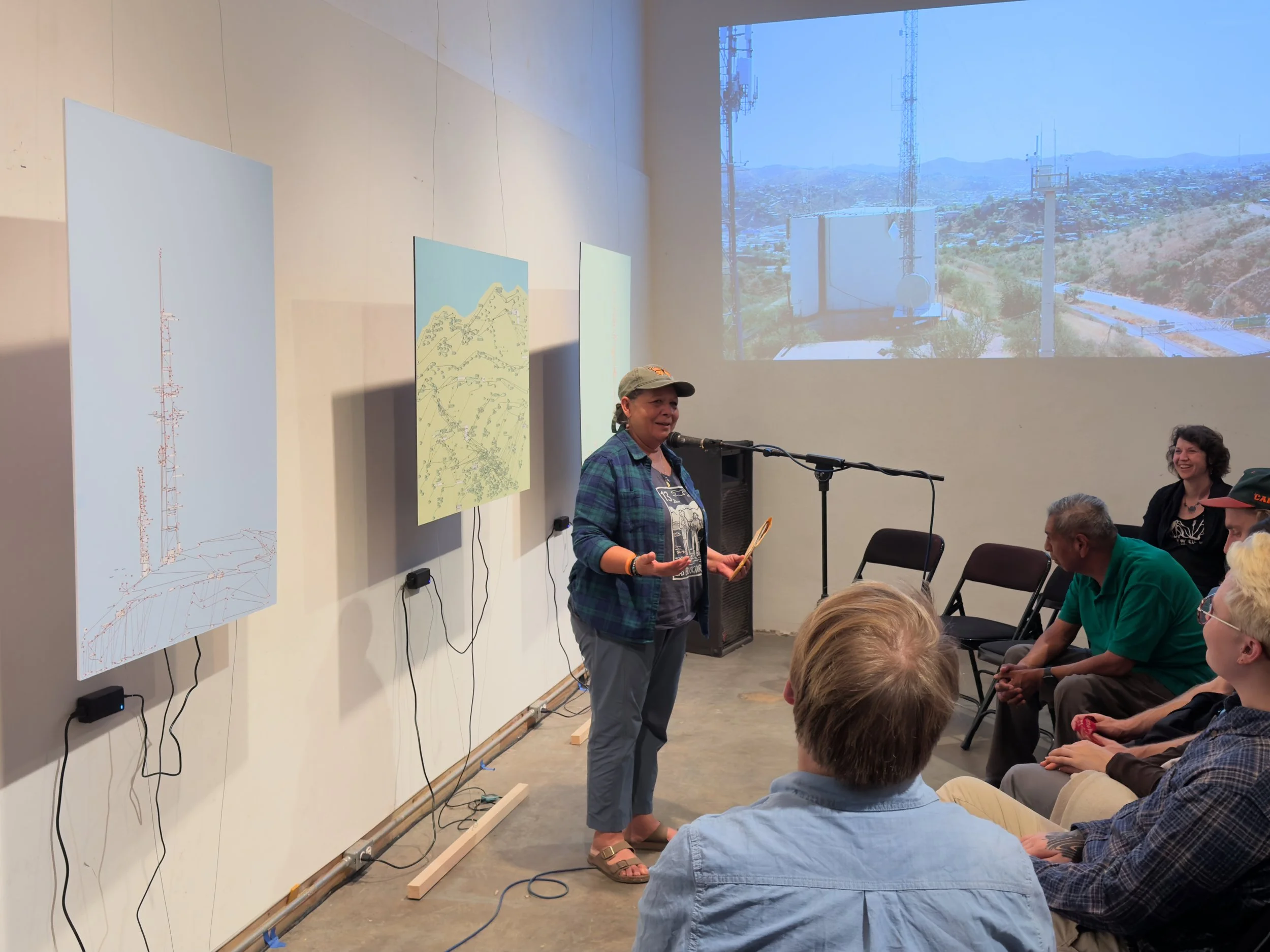
Dora Rodriguez, advocate for migration justice, speaking at the closing event of Border Signals, Wave Archive, October, 19, 2025, Tucson, AZ
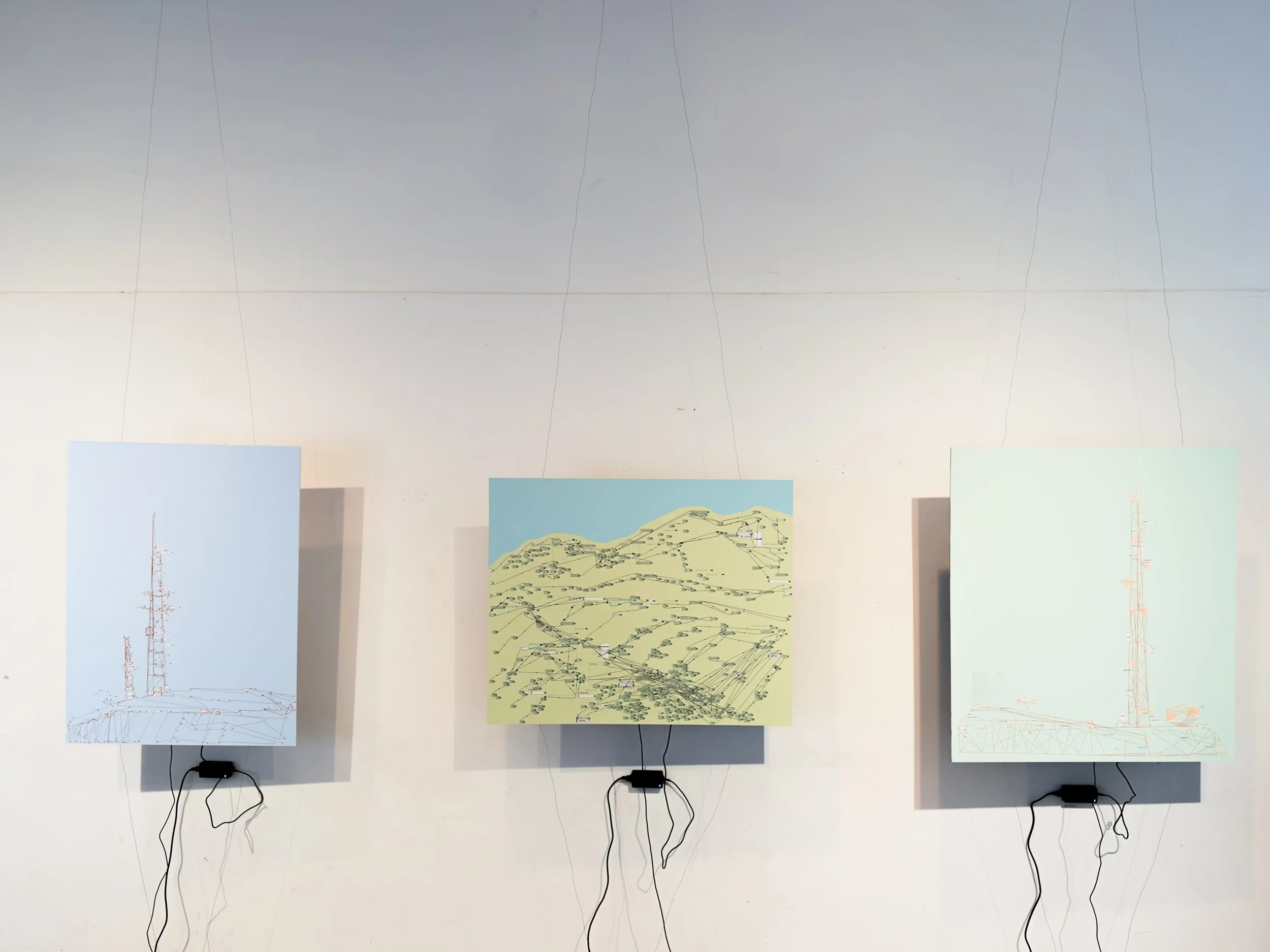
Three multimedia pieces by Robert Henderson. Border Signals exhibit, Wave Archive, October 2025
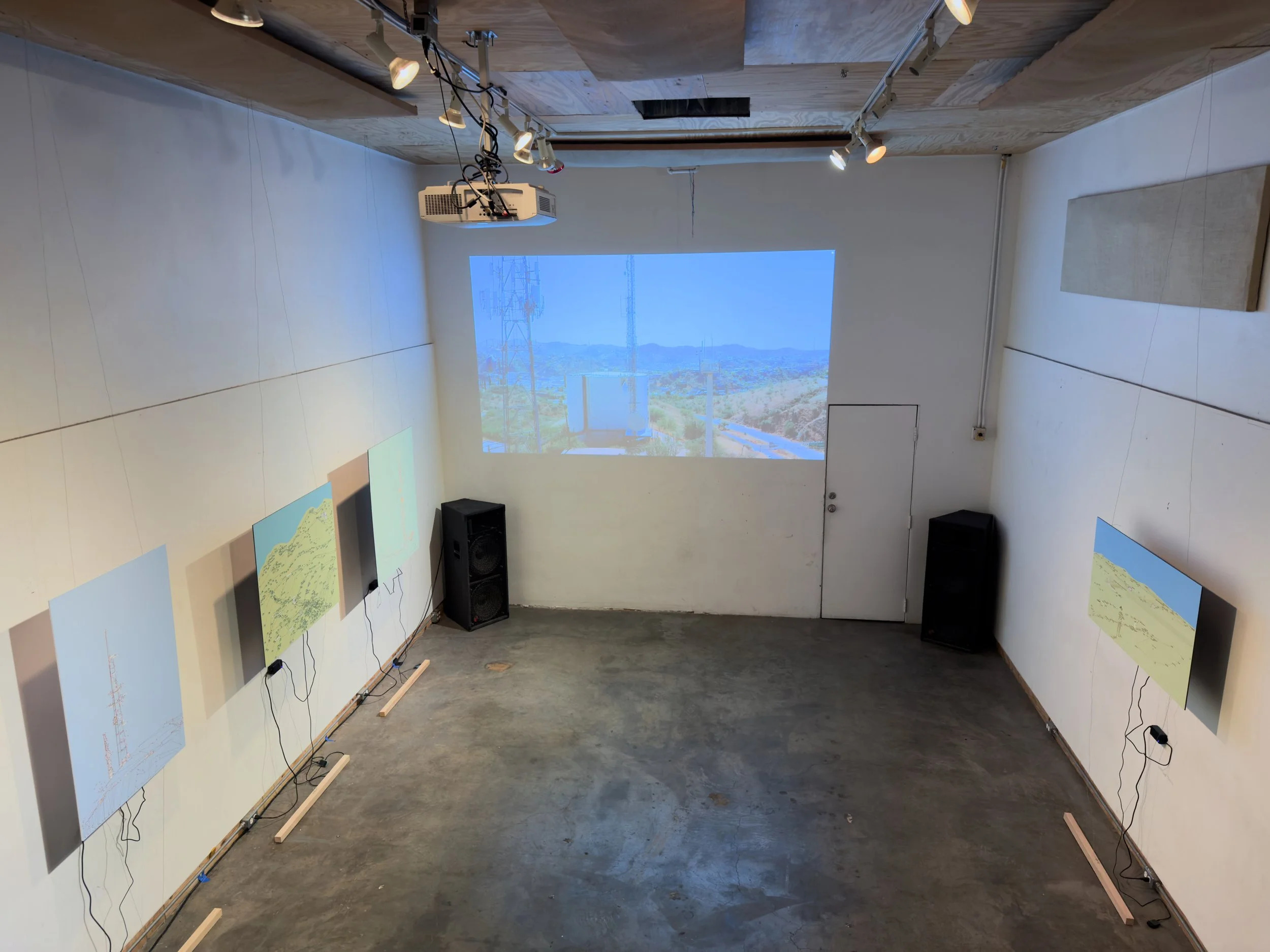
Video art by David Taylor (facing wall) and multimedia art by Robert Henderson, Border Signals Exhibit, October 2025
On Sunday March 8, 2026, you are invited to return with us to the US Mexico border region for a third, separate but related iteration of this project: a plein air painting workshop led by Robert Henderson at the Whitewater Draw bird sanctuary from 11:00am-2:00pm. Please bring water, a hat, pencils / charcoal, a sketch pad and any other art supplies you may wish to have, and a packed lunch.
Whitewater Draw is the winter home of sandhill cranes, a species with one of the longest migratory paths in the world. Workshop participants will be introduced to basic drawing and landscape painting skills with an emphasis on framing, perspective, and representing difference and relation in both background and foreground. Two wooden frames will be temporarily erected and divided into quadrants. Painters will then be assigned a single quadrant and asked to paint what they see through that framework. Completed paintings will be installed on the frames in their relative quadrants to form two pieces — a fleeting record of the multiple vantage points, and ways of seeing, that created them. Both paintings and frames will then serve as the basis of a sound art installation that both extends and responds to the first two iterations of this project: the Border Signals exhibit in October 2025 at Wave Archive in Tucson, AZ, and the initiating event in Nogales, AZ, in November 2024. With this latest iteration we return to the concept "Lines of Flight," which--more than referring to singular trajectories, or ways of moving, across or along defined boundaries---draws attention to the power of bodies to affect and be affected by one another. As well as to how every actualized connection between bodies creates new points of departure, and grounds for both action and response.
Test run at Whitewater Draw, February 1, 2026